Sticking a landing will royally fuck up your joints and possibly shatter your ankles, depending on how high you’re jumping/falling from. There’s a very good reason free-runners dive and roll.
Hand-to-hand fights usually only last a matter of seconds, sometimes a few minutes. It’s exhausting work and unless you have a lot of training and history with hand-to-hand combat, you’re going to tire out really fast.
Arrows are very effective and you can’t just yank them out without doing a lot of damage. Most of the time the head of the arrow will break off inside the body if you try pulling it out, and arrows are built to pierce deep. An arrow wound demands medical attention.
Throwing your opponent across the room is really not all that smart. You’re giving them the chance to get up and run away. Unless you’re trying to put distance between you so you can shoot them or something, don’t throw them.
Everyone has something called a “flinch response” when they fight. This is pretty much the brain’s way of telling you “get the fuck out of here or we’re gonna die.” Experienced fighters have trained to suppress this. Think about how long your character has been fighting. A character in a fist fight for the first time is going to take a few hits before their survival instinct kicks in and they start hitting back. A character in a fist fight for the eighth time that week is going to respond a little differently.
ADRENALINE WORKS AGAINST YOU WHEN YOU FIGHT. THIS IS IMPORTANT. A lot of times people think that adrenaline will kick in and give you some badass fighting skills, but it’s actually the opposite. Adrenaline is what tires you out in a battle and it also affects the fighter’s efficacy – meaning it makes them shaky and inaccurate, and overall they lose about 60% of their fighting skill because their brain is focusing on not dying. Adrenaline keeps you alive, it doesn’t give you the skill to pull off a perfect roundhouse kick to the opponent’s face.
Swords WILL bend or break if you hit something hard enough. They also dull easily and take a lot of maintenance. In reality, someone who fights with a sword would have to have to repair or replace it constantly.
Fights get messy. There’s blood and sweat everywhere, and that will make it hard to hold your weapon or get a good grip on someone.
A serious battle also smells horrible. There’s lots of sweat, but also the smell of urine and feces. After someone dies, their bowels and bladder empty. There might also be some questionable things on the ground which can be very psychologically traumatizing. Remember to think about all of the character’s senses when they’re in a fight. Everything WILL affect them in some way.
If your sword is sharpened down to a fine edge, the rest of the blade can’t go through the cut you make. You’ll just end up putting a tiny, shallow scratch in the surface of whatever you strike, and you could probably break your sword.
ARCHERS ARE STRONG TOO. Have you ever drawn a bow? It takes a lot of strength, especially when you’re shooting a bow with a higher draw weight. Draw weight basically means “the amount of force you have to use to pull this sucker back enough to fire it.” To give you an idea of how that works, here’s a helpful link to tell you about finding bow sizes and draw weights for your characters. (CLICK ME)
If an archer has to use a bow they’re not used to, it will probably throw them off a little until they’ve done a few practice shots with it and figured out its draw weight and stability.
People bleed. If they get punched in the face, they’ll probably get a bloody nose. If they get stabbed or cut somehow, they’ll bleed accordingly. And if they’ve been fighting for a while, they’ve got a LOT of blood rushing around to provide them with oxygen. They’re going to bleed a lot.
Here’s a link to a chart to show you how much blood a person can lose without dying. (CLICK ME)
If you want a more in-depth medical chart, try this one. (CLICK ME)
Hopefully this helps someone out there. If you reblog, feel free to add more tips for writers or correct anything I’ve gotten wrong here.
How to apply Writing techniques for action scenes:
– Short sentences. Choppy. One action, then another. When there’s a lull in the fight, take a moment, using longer phrases to analyze the situation–then dive back in. Snap, snap, snap. – Same thing with words – short, simple, and strong in the thick of battle. Save the longer syllables for elsewhere. – Characters do not dwell on things when they are in the heat of the moment. They will get punched in the face. Focus on actions, not thoughts. – Go back and cut out as many adverbs as possible. – No seriously, if there’s ever a time to use the strongest verbs in your vocabulary – Bellow, thrash, heave, shriek, snarl, splinter, bolt, hurtle, crumble, shatter, charge, raze – it’s now. – Don’t forget your other senses. People might not even be sure what they saw during a fight, but they always know how they felt. – Taste: Dry mouth, salt from sweat, copper tang from blood, etc – Smell: OP nailed it – Touch: Headache, sore muscles, tense muscles, exhaustion, blood pounding. Bruised knuckles/bowstring fingers. Injuries that ache and pulse, sting and flare white hot with pain. – Pain will stay with a character. Even if it’s minor. – Sound and sight might blur or sharpen depending on the character and their experience/exhaustion. Colors and quick movements will catch the eye. Loud sounds or noises from behind may serve as a fighter’s only alert before an attack. – If something unexpected happens, shifting the character’s whole attention to that thing will shift the Audience’s attention, too. – Aftermath. This is where the details resurface, the characters pick up things they cast aside during the fight, both literally and metaphorically. Fights are chaotic, fast paced, and self-centered. Characters know only their self, their goals, what’s in their way, and the quickest way around those threats. The aftermath is when people can regain their emotions, their relationships, their rationality/introspection, and anything else they couldn’t afford to think or feel while their lives were on the line.
Do everything you can to keep the fight here and now. Maximize the physical, minimize the theoretical. Keep things immediate – no theories or what ifs.
If writing a strategist, who needs to think ahead, try this: keep strategy to before-and-after fights. Lay out plans in calm periods, try to guess what enemies are thinking or what they will do. During combat, however, the character should think about his options, enemies, and terrain in immediate terms; that is, in shapes and direction. (Large enemy rushing me; dive left, circle around / Scaffolding on fire, pool below me / two foes helping each other, separate them.)
Lastly, after writing, read it aloud. Anyplace your tongue catches up on a fast moving scene, edit. Smooth action scenes rarely come on the first try.
I’m asked at least once a week how to get published. Once upon a time, this was a very straightforward answer:
1. Write a novel.
2. Write a query letter.
3. Send the query letter to agents or to editors.
4. Rinse and repeat until said agents and editors ask to see the rest.
5. Rinse and repeat until they see the rest and ask to buy it.
5. In the case of multiple offers, speak to all parties on the phone and see which one makes you feel like the prettiest pony.
Here were things you did not do:
1. Pay to be published.
2. Pay your agent anything besides 15% of the sale price of your book and your royalties.
3. Pay for any of the costs associated with being published such as cover design, editing, printing, hiring of performing bears, etc.
4. Do anything other than write and be paid for writing.
But now there are many ways to be published. Self-publishing and small publishers no longer have the same stigma attached to them. It is no longer the most obvious thing to say: to get published, write a query letter and submit it to an agency or a publishing house, DONE.
Instead, you must ask yourself: what is my goal in publishing?
If your goal is to write a book that you hope will appear on the shelves of Barnes & Noble, CostCo, and supermarkets everywhere, you still need to follow the first set of steps. A traditional publisher is still your only way to get into all of those places. And if you really do have your eye on stands in supermarkets and Sam’s Club and airports, you not only need a traditional publisher, but you need a large traditional publisher of the sort that generally exists in New York and is called something like Little, Brown, or Scholastic, or Random House. You will also need an agent.
You will need, as I said before, to do all of the steps I first listed.
If your goal is to write a book that you’d like to see on shelves but are fine with those shelves being the ones in specialty stores or libraries or schools, a smaller traditional publisher might be a good option for you. This is especially true if you’ve written a less commercial book. (here is a good way to judge if something is commercial: can you imagine your mother, your hair dresser, your veterinarian, and your brother in law all reading it? if so, it is super commercial. Commercial =/= good. It merely means many people will pick it up).
These smaller houses will carry the burden of editing and printing and marketing for you, but they won’t always have the clout to get your book into major stores. They are, however, often less competitive than the larger New York houses, and they will often give you more personal attention and promote your book for longer. You don’t always need an agent to submit to them either, though I recommend an agent if you’re pursuing a full-time career in writing.
But if your goal is only to be read, or to if you have a keen marketing mind and want to represent yourself, self-publishing is an emerging option. You’ll have all of the control, and there will be no rejection letters in your future. But you’ll also carry the entire burden of cover design, editing, printing, formatting for digital distribution and, most importantly, marketing and publicity. I was a self-representing artist, and success is possible, but it will look different than success at a traditional larger house, and it will ask different things from you. You will not, at this point, ever walk into a Sam’s Club and see a self-published title sitting on the table out front. It is very possible to be a writer without Sam’s Club. But it’s important to keep that in mind if a big commercial career is what you long for — the book on that table bears the logo of a large traditional publishing house.
A note: There are several companies that offer to help you with self/ digital-only publishing at the moment, but I’m not convinced of their usefulness at this point. I think it’s a little too soon to see how they’re anything but a middle man at this stage. My feelings are if you’re going to dive into the digital world, you should be doing it because you want the freedom and control in your own hands.
What it comes down to is that you need to be honest with what you need out of your publishing experience. Unhappiness comes from wrong-headed expectations and targeting the wrong house. If you long to see your book at O’Hare airport, you’re going to have a miserable experience self-publishing. If you want to publish a serial story in ten parts over two years, you’re going to have a hard time pitching it to a traditional house. Don’t expect a small house to suddenly change its stripes and drop a quarter million marketing budget on your novel.
DO YOUR RESEARCH.
Make a list of books and careers that you admire and would like to model, and then work backward to find out how those authors ended up where they were. And if something sounds too good to be true, it is. Consider suspect any option that seems like it doesn’t require rejection and work and practice and polish and scrabbling of your hands and teeth. This is the best job in the world, which means there are a lot of people who are fighting for it. If you really want it, you’ll fight alongside with them.
I made these as a way to compile all the geographical vocabulary that I thought was useful and interesting for writers. Some descriptors share categories, and some are simplified, but for the most part everything is in its proper place. Not all the words are as useable as others, and some might take tricky wording to pull off, but I hope these prove useful to all you writers out there!
art block is your brain telling you to do studies.
draw a still life. practice some poses. sketch some naked people. do a color study. try out a different technique on a basic shape.
art block doesnt stop you from drawing, it stops you from making your drawings look the way you want them to. and thats because you need to push your skills to the next level so you can preform at that standard
think of it as level grinding for your next work.
As a scientific illustrator- this is 100% true and going to review your basics will fix it every goddamn time. Not only does it keep your skills sharp, when you’re not emotionally invested in the final product of a piece, you relax and your brain makes more/better art juice for you. So, when you get back to that big/important piece? You’ll know what to do and how to do it.
Nothing in nature blooms all year round. Rest, and take care of yourself.
Dont @ me but if ur a white content creator u should probably examine your brown characters (especially the darker skinned ones) and see if u aren’t following a certain trend of making them all aggressive, violent, surly or otherwise outwardly angry
Honestly this comes insidiously in subtle ways I think
Are your brown characters always scowling in the art u draw? How about emotionless asians? Do u have white antagonistic characters that get to be cute or beautiful, while ur brown characters ONLY get to be confrontational?
one of my ex-friends once asked me and my sister (both of us being filipino) how to say rude or mean things in filipino for her character and never asked anything else about being filipino-american
The opening scene is the most important piece of your novel. This scene determines whether your reader is pulled in or puts the book down. Here are some important do’s and don’ts.
DO write it as a scene, not a data dump. You may have a fantastic premise, a marvelous alternate history or post-apocalyptic world or magical realism to die for, but if you don’t engage your reader in an actual scene, you will bore them.
DO write a scene that immediately introduces a character that the reader can root for. Yes, I know Stephen King has had great success introducing victims that are then shortly afterward killed off. That’s a horror trope and we expect it. But if you are caught up in world-building and haven’t dreamed your way into a character who is worth following through 100,000 words of writing, your story is pointless. I have read many pieces of fiction by would-be writers who can’t grasp this essential concept, and without exception, they fail to engage the reader.
DO introduce the stakes right away. In case that’s a challenge that needs some exposition to develop, create some immediate stakes (a life threat works) that keep the tension high and the reader engaged until you can lay out the larger stakes.
DO begin in medias res, which means “in the middle of things.” Most beginning fiction writers make the mistake of starting too early in the plot. Meet the monster on page 1.
DON’T include a flashback in the first chapter. Work on a scene, which means time is NOT compressed. It should include dialog, action, description, setting, and interior monolog. Keep everything happening within that scene for at least the first chapter. You can bring in a flashback in Chapter Three.
DON’T shift points of view within a single chapter. Let the reader establish a strong bond of interest (even if it’s with a POV villain) over the course of a whole chapter.
DON’T open the story with your character waking up unless it’s because she’s got a gun in her face (or a knife to her throat – you get what I mean). We don’t need to follow a character through their mundane daily routine.
DON’T be coy. Beginning writers often have this idea that they need to hold back on revealing all their secrets – what’s in the box, who’s behind the curtain, where they’re going next, etc. Their well-meant plan is to slowly reveal all this over several chapters. Trust me on this one: tell your readers instead of keeping it a mystery. You WILL come up with more secrets to reveal. Your imagination is that good. Spill it now, and allow that revelation to add to the excitement.
so I’m looking at short story publishers (fantasy)
Tor, cream of the crop. 25 cents a word. Stories can be read for free (YES). Slowish response time at ~3 months. Prefer under 12k, absolute maximum is 17.5k. Don’t bother if it’s not highly professional quality. SFWA qualifying.
Crossed Genres. 6 cents a word. Different theme each month (this month’s is “failure”). Submissions must combine either sci-fi or fantasy with the theme. Response time 1 month. 1k-6k, no exceptions. SFWA qualifying.
Long Hidden, anthology from CG. 6 cents a word. 2k-8k, no exceptions. Must take place before 1935. Protagonist(s) must be under 18 and marginalized in their time and place. Must be sci-fi/fantasy/horror. Deadline 30 April. Response by 1 October.
Queers Destroy Science Fiction. Sci-fi only right now, author must identify as queer (gay, lesbian, bi, ace, pan, trans, genderfluid, etc, just not cishet). 7.5k max. Deadline 15 February. Responses by 1 March. You can submit one flash fiction and one short story at the same time. (My network blocks the Lightspeed site for some reason, so I can’t get all the submission details. >_>) Probably SFWA qualifying?
Women in Practical Armor. 6 cents a word. 2k-5k. Must be about 1) a female warrior who 2) is already empowered and 3) wears sensible armour. Deadline 1 April. Response within three months.
Fiction Vortex. $10 per story, with $20 and $30 for editor’s and readers’ choice stories (hoping to improve). Speculative fiction only. Imaginative but non-florid stories. 7.5k maximum, preference for 5k and under. (I kind of want to support them on general principle.)
Urban Fantasy Magazine. 6 cents a word. 8k max, under 4k preferred. Must be urban fantasy (aka, the modern world, doesn’t need to be a literal city).
Nightmare. 6 cents a word. 1.5-7.5k, preference for under 5k. Horror and dark fantasy. Response time up to two weeks. SFWA and HWA qualifying.
Apex Magazine. 6 cents a word. 7.5k max, no exceptions. Dark sci-fi/fantasy/horror. SFWA qualifying.
Asimov’s Science Fiction. 8-10 cents a word. 20k max, 1k minimum. Sci-fi; borderline fantasy is ok, but not S&S. Prefer character focused. Response time 5 weeks; query at 3 months. SFWA qualifying, ofc.
Buzzy Mag. 10 cents a word. 10k max. Should be acceptable for anyone 15+. Response time 6-8 weeks. SFWA qualifying.
Strange Horizons. 8 cents a word. Speculative fiction. 10k max, prefers under 5k. Response time 40 days. Particularly interested in diverse perspectives, nuanced approahces to political issues, and hypertexts. SFWA qualifying.
Fantasy and Science Fiction. 7-12 cents a word. Speculative fiction, preference for character focus, would like more science-fiction or humour. 25k maximum. Prefers Courier. Response time 15 days.
Scigentasy. 3 cents a word. .5-5k. Science-fiction and fantasy, progressive/feminist emphasis. Fantastic Stories of the Imagination. 15 cents a word. 3k maximum. Any sci-fi/fantasy, they like a literary bent. (psst, steinbecks!) They also like to see both traditional and experimental approaches. Response time two weeks.
Beneath Ceaseless Skies. 6 cents a word. 10k maximum. Fantasy in secondary worlds only (it can be Earth, but drastically different—alternate history or whatever). Character focus, prefer styles that are lush yet clear, limited first or third person narration. Response time usually 2-4 weeks, can be 5-7 weeks. SFWA qualifying.
Clarkesworld. 10 cents a word up to 4000, 7 afterwards. 1-8k, preferred is 4k. Science-fiction and fantasy. Needs to be well-written and convenient to read on-screen. Appreciates rigour. No talking cats. Response time 2 days. SFWA qualifying.
Orson Scott Card’s Intergalactic Medicine Show. 6 cents a word. Any length. Science-fiction and fantasy (along with fantastic horror). Good world-building and characterization. Clear straightforward prose. Response time three months. Yes, OSC is editor-in-chief. SFWA qualifying.
Interzone. Sub-pro rates if anything (but highly respected). 10k max. Short cover letter. Science-fiction and fantasy.
If some of y’all weren’t a bunch of cowards, we could have a
hero with a big, nasty scar. Not a cute little cut over one eye or across their
nose, I’m talking about people who have half their face burned off.
“Oh so like a gritty antihero who –“ NO I MEAN A BEAUTIFUL
RAY OF SUNSHINE WHO HAS HALF THEIR FACE BURNED OFF BECAUSE THEY GOT
INTO A BIG BLOODY BATTLE AGAINST THE EVIL BAD GUY. THEY’RE NOT CYNICAL OR
MEAN-SPIRITED OR BAD THEY’RE A TOTAL SWEETIE NOW SHUT UP AND MAKE IT YOU
COWARDS!
EDIT: Ugh, I hate the way I worded the OP. I hate it when
other people word posts like this and instead of simply suggesting “Hey, here’s
a character concept few people try that should be utilized more,” they attack people
for lacking that particular concept in their roster.
Anyway, I have read a few posts about how the only time you
see very badly, messily scarred or deformed characters are when said characters
happen to be villains, with very few exceptions (the one I can think of off the
top of my head being Quasi Modo), written by someone who works in a pediatric
burn unit ward. It upset me, reading about how negatively it affects little
kids and kind of made me think Hollywood and mainstream fictional media need to
stop reserving their heroic roles for only the most pristine-looking characters
(sure, there are exceptions, but not many).
Still, I hate how the initial post came out. Too accusatory,
too self-unaware and detached, everything I hate out of the average Tumblr
post.
So let me rephrase: You know what would be great? A badly
scarred character who isn’t a villain. Who isn’t even a gritty, cynical
antihero. Who isn’t even mean. No, a total ray of sunshine who’s sweet and kind
with a big nasty scar that mars up half their face. I don’t mean a cute little scar
over their eye or on the bridge of their nose either, I mean A BIG, NASTY,
IMPOSSIBLE-TO-IGNORE SCAR LIKE A BURN OR TORN-UP FLESH OR A BIG GASH OR PART OF
THEIR HAIR BEING MISSING BECAUSE THE SCALP WAS BURNT/RIPPED OFF DOWN TO THE
FOLICLE. And they’re a sweet, beautiful cinnamon roll all the while. I want
that.
One of my favorite studies of Harry Potter is that of the ring composition found both in the individual novels and overall composition. To me, that very composition is what makes Harry Potter such a satisfying story. In my view, it’s a large part of the reason Harry Potter is destined to become a classic.
And it’s an integral part of the series many people are completely unaware of.
So what is ring composition?
It’s a well-worn, beautiful, and (frankly) very satisfying way of structuring a story. John Granger, known online as The Hogwarts Professor, has written extensively on it.
Ring Composition is also known as “chiastic structure.” Basically, it’s when writing is structured symmetrically, mirroring itself: ABBA or ABCBA.
Poems can be structured this way. Sentences can be structured this way. (Ask not what your country can do for you — ask what you can do for your country.) Stories of any length and of any form can be structured this way.
In a novel, the basic structure depends on three key scenes: the catalyst, the crux, and the closing.
The catalyst sets the story into the motion.
The crux is the moment when everything changes. (It is not the climax).
The closing, is both the result of the crux and a return to the catalyst.
In Harry Potter, you might recognise this structure:
Voldemort casts a killing curse on Harry and doesn’t die.
Voldemort attempts to come back to power
Voldemort comes back to power.
Harry learns what it will take to remove Voldemort from power.
Voldemort casts a killing curse on Harry and dies.
But all stories should have this structure. A book’s ending should always reference its beginning. It should always be the result of some major turning point along the way. Otherwise, it simply wouldn’t be a very good story.
What’s most satisfying about chiastic structure is not the basic ABA structure, but the mirroring that happens in between these three major story points.
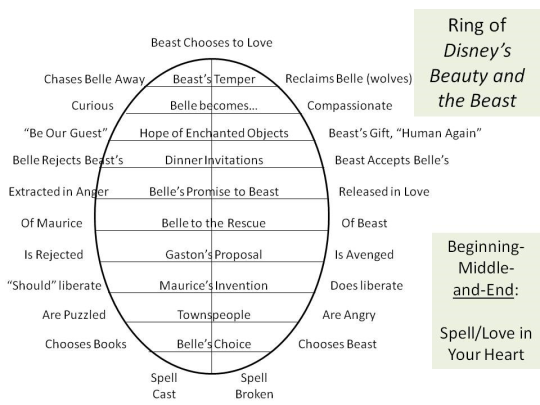
To illustrate what a more complicated ABCDEFGFEDCBA structure looks like, (but not as complicated as Harry Potter’s, which you can see here and here) Susan Raab has put together a fantastic visual of ring composition in Beauty and the Beast (1991), a movie which most agree is almost perfectly structured.
What’s so wonderful about ring composition in this story is that it so clearly illustrates how that one crucial decision of Beast changes everything in the world of the story. Everything from the first half of the story comes back in the second half, effected by Beast’s decision. This gives every plot point more weight because it ties them all to the larger story arc. What’s more, because it’s so self-referential, everything feels tidy and complete. Because everything has some level of importance, the world feels more fully realized and fleshed out. No small detail is left unexplored.
How great would Beauty and the Beast be if Gaston hadn’t proposed to Belle in the opening, but was introduced later on as a hunter who simply wanted to kill a big monster? Or if, after the magnificent opening song, the townspeople had nothing to do with the rest of the movie? Or if Maurice’s invention had never been mentioned again after he left the castle?
Humans are nostalgic beings. We love returning to old things. We don’t want the things we love to be forgotten.
This is true of readers, too.
We love seeing story elements return to us. We love to know that no matter how the story is progressing, those events that occurred as we were falling in love with it are still as important to the story itself as they are to us. There is something inside us all that delights in seeing Harry leave Privet Dr. the same way he got there–in the sidecar of Hagrid’s motorbike. There’s a power to it that would make any other exit from Privet Dr. lesser.
On a less poetic note, readers don’t like to feel as though they’ve wasted their time reading about something, investing in something, that doesn’t feel very important to the story. If Gaston proposed to Belle in Act 1 and did nothing in Act 3, readers might ask “Why was he even in the movie then? Why couldn’t we have spent more time talking about x instead?” Many people do ask similar questions of plot points and characters that are important in one half of a movie or book, but don’t feature in the rest of it.
Now, ring composition is odiously difficult to write, but even if you can’t make your story a perfect mirror of itself, don’t let story elements leave quietly. Let things echo where you can–small moments, big moments, decisions, characters, places, jokes.
It’s the simplest way of building a story structure that will satisfy its readers.
If there’s no place for something to echo, if an element drops out of the story half-way through, or appears in the last act, and you simply can’t see any other way around it, you may want to ask yourself if it’s truly important enough to earn its place in your story.
Further reading:
If you’d like to learn more about ring theory, I’d recommend listening to the Mugglenet Academia episode on it: x
You can also read more about symmetry in HP here: x
And more about ring structure in Lolita and Star Wars here: x and x
And about why story endings and beginnings should be linked here: x
 bullshit central
