Even though this is one of the shortest scenes, I think, of the entire show, it’s one of my favorites.
On the surface, you think it’s just about Bradley: that his life is truly sad because he’s had absolutely no control over it from the second he was selected to be a potential Fuhrer candidate.
But if you read more deeply into the dialogue, Bradley mainly serves as a foil to Hawkeye’s character in this scene.
Riza joined the military academy of her own volition. She has her own goals to accomplish, her own motives, and her own reasons to keep moving forwards. The position she now holds is entirely based on her own decisions and actions, and on merit. Bradley, I’m sure, is somewhat envious of that. Because he’s really only a puppet. Father’s the one pulling all the strings. He hasn’t earned his rank or status or even his power, and he knows it. Hawkeye, in this regard, leads a life far superior to his.
But look at the way she reacts when he tells her that he was able to marry the woman of his own choosing. She freezes — stops what she’s doing entirely. Because no matter how pathetic or sad Bradley’s life is, he still has something that Riza doesn’t: the right to be with the person he loves.
That’s what this scene is really about. Bradley is telling her, “Pity me all you want, but I have the one thing you don’t — the one thing you want but can’t have”.
She and Roy don’t have the right to share “I love you”s at the end of the day. And he’s having fun reminding her that she can’t have him. He likes to drive the stake in her chest even deeper than it already is. (I mean, look at the way the bastard smiles in that last gif).
And honestly, he probably fucks with her feelings like this constantly once he appoints her to be his aide.
Okay but can we talk about how when Father first met the Elric brothers he immediately dropped his cold and calculated disposition? It really just breaks my heart because here is the main villain meeting the children of his former best friend and instead of acting borderline robotic like he does for the rest of the story he laughs and pats Ed on the head like “Well would you look at that! Hohenheim actually went and got the family he always wanted! My buddy did it!”
I just feel like it really says a lot about the hidden depth of his character, and I just love the little details like this you’d only really catch if you pay attention. Idk I think about this moment a lot. I love this series so much.
I feel like this was kinda a subtle reminder that he was more human than he thought he was? I mean his whole goal was to “transcend” to godhood or such and in all of that he was trying his best to strip away what connected him to broken, mortal, pathetic human beings(example: taking away his faults, a very defining human trait) but he forgot that humans are more than just their deadly flaws?? Like humanity is super crappy, but we have our good sides too, mostly found in relationships. We bring the good things out of each other and we thrive on each other’s company. Even as he tried to prove to the world that “I’m beyond petty humans” he couldn’t help but find a little human in himself as he remembered his friend and his friend’s dream and felt the joy in his accomplishments.
There is an explanation for this behavior: Hehad Greed reattached to his soul when this scene happened, which says a lot about the nature of Greed’s personality and what part of Father he was: Ergo, Greed was the part of The Dwarf in the Flask/Homunculus/Father that was friendly, personable, and wanted to have and maintain connections with other people. This is why it makes sense that in the end, Greed realized that the one thing he truly wanted was friends – he was above all else, comprised of The Dwarf’s discarded desire for companionship.
Hohenheim even makes a comment that makes reference to this when he meets The Dwarf again as Father; that The Dwarf had been a much more interesting person back when he was just a little ball in a flask, long before he separated the sin homunculi from himself.
This also helps explain why after he removed Greed from himself again, Father’s personality went back to being that of a calculating, robotic villain.
ling: yeah ill just go over to another country and get this special rock, then i’ll become emperor. easy. no big deal.
ling, after traveling across the desert, getting imprisoned, getting busted out by a serial killer with no body, staying at his apparently new best friends hotel room and helping him try to catch a homunculus, catch said homunculus but his body guard loses her arm in a fight with the to the leader of the country who’s also a homunculus, getting eaten and sent to a hell-like stomach in another plane of existence covered in blood where he eats his friend’s shoe, fighting a giant monster with faces of the damned covering them, coming back by crossing through god’s territory, finding the stone but becoming infused with it and now he has to share his body with a homunculus named greed who unsurprisingly hogs the body most of the time, after like 3 months he reunites with his friend in a cabin in the woods who now has two half-animal dudes with him, helping overthrow the corrupt government of this country but losing the lives of one of his body guards, living through an apocalypse, losing greed who he became close with and thus becoming human again, and helping kill god: you know what i think i was oversimplifying it a bit at first
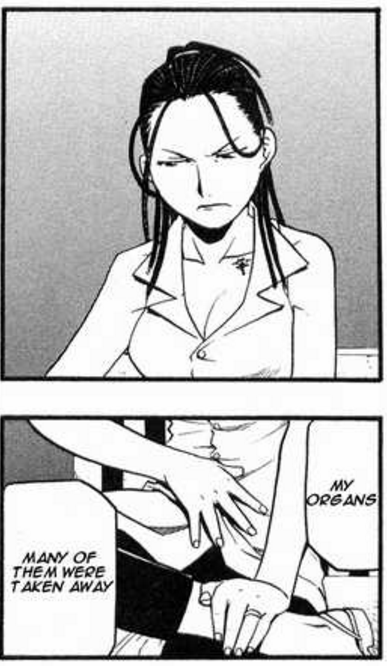
Of all the many wonderful, complex characters in Fullmetal Alchemist, I find that Izumi Curtis is one of the most nuanced and original, both within the series and in the shounen manga field. In a genre full of dead mothers and overbearing harpies, Izumi stands apart as a physically and magically talented fighter who is also an “ordinary housewife”; she has, most unusually for a shounen manga female character, survived not only childbirth but also an horrific, failed attempt to resurrect her dead baby.
She is chastened but not broken by the experience. Izumi is the only female alchemist within the series to have seen “the Truth.” Her payment is highly gendered – I take “my organs” (or “some of my insides,” as another scanslation group renders it) to mean her womb and ovaries. And she is the only character whose payment is neither returned nor compensated for with automail or a surrogate body*.
I think it is so gutsy (no pun intended) of Arakawa to have Izumi remain in this state. It feels so radical to see a woman whose worth extends far beyond her ability to give birth. Who lost a child but still finds meaning in her family, work, and community. Who has a fulfilling life but still mourns for and thinks about her lost baby, even after her guilt is assuaged. In another author’s hands, Izumi would be long dead, a woman with no value beyond her womb, existing only to provide fodder for another character’s development. Or she would be a villain, a broken woman madly hungering for what she cannot have. Or she would have her organs restored, and be shown pregnant or holding a newborn at the series end. Instead, Arakawa gives us a female character who is both happy and wanting, powerful and poignant, and presents those dualities as valid, inseparable aspects of a whole.
*Within the context of the FMA universe, adoption is shown as an option, but one which the Curtises appear not to have pursued. Surrogate pregnancy, I believe, is not discussed within the series.

 bullshit central