Before I get going, I’m 75% deaf, as some of you know, semi-reliant on hearing aids and lip reading. My first languages were Makaton sign and then BSL. I now use spoken English.
There are a lot of issues I find with how deaf people are represented in books, when represented at all. I would love to see more deaf and hard of hearing characters in the books I read- without having to read books specifically about deaf/HoH people- but when I find them, they’re grossly undercharacterized or stereotyped. Authors write them in a way that sets signing language characters apart from speaking characters as if they are inferior, and this makes my blood boil.
Some technicalties
I’ll keep this brief.
You may have heard that “deaf” is a slur and you should use “hearing impaired”. Don’t. I’ve never met a deaf or hard of hearing person who believed that. Use deaf for people who are deaf, and Hard of Hearing (HoH) for people who lack hearing. These can be interchangeable depending on the person. This is why sensitivity readers are a useful part of the beta process.
Sign language is incredibly varied. It developes in the same way as spoken language. Fun fact: in BSL there are at least half a dozen ways to say bullshit, my favourite of which is laying your arms across one another with one hand making a bull’s head sign and the other hand going flat, like a cowpat. It’s beautifully crude, and the face makes the exclamation mark. Wonderful.
There are different sign languages. Knowing more than one would make a character multi or bi-lingual, even if they are non-speaking.
Makaton is basic sign language used by children, and it mirrors the very simple language used by toddlers.
Yes, we swear and talk shit about people around us in sign language sometimes, and no, it isn’t disrespectful to have signing characters do this. Just remember that we also say nice things, and random things, and talk about fandoms and TV shows and what we’re having for dinner, too.
Each signed language is different from another. ASL and BSL? Nothing alike. Just google the two different signs for horse.
Remember that sign language is a language, equal to the spoken word
Therefore, treat it as such. Use quotation speech marks and dialogue
tags. You only need to explicitly state that this character uses signed language once, and then let your modifiers and description do the rest.
It isn’t a form of “sub-speech" or “making hand actions”- sign language is a language all on its own: it has its own grammar rules, syntactical structures, punctuation, patterns, idioms and colloquialisms. For example, “what is your name?” becomes “Your name what?” with the facial expression forming punctuation in the same way that spoken English uses alterations of prosodic tone (inflections). There is even pidgin sign; a language phenomenon usually associated with spoken language.
In the same way that you would describe a spoken-English character’s tone of voice, you would describe a signed-English speaker’s facial expressions and the way that they sign- keeping in mind that these things are our language’s equivalent of verbal inflection.
So please, none of that use of “special speech marks” or italicised
speech for sign. If your viewpoint character doesn’t understand signed
speech, then you take the same approach that would be used for any other
language they don’t understand, like French or Thai. E.g “He said something
in rapid sign language, face wrinkling in obvious disgust.” is a good
way of conveying this. The proof that you’ve done this well is in whether or not you can switch “sign language” for French or something else, and it would read the same.
Don’t be afraid to describe how things are said, either.
Sign language is such a beautiful and expressive way of talking, and to
see a writer do it justice would be truly fabulous. Putting this into practise:
“Oh, I love maths!” She said, fingers sharp and wide with sarcasm. She raised her eyebrows.
“I’m sorry.” He replied and made his face small, but could not keep the grin forming. She was starting to laugh, too.
This is part one of two, for the sake of readability and keeping the information simple as I can. Part two- writing the deaf characters themselves- is coming up over the weekend. See you then and best luck with your writing until that point 😀
This is part of my weekly advice theme. Each week I look at what you’ve asked me to help with, and write a post or series of posts for it. Next week: settings and character development (including heroes, anti-heroes, villains, and every other kind of character).
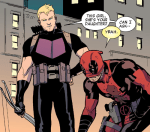
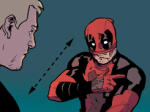
I really appreciated all the little nods to Clint’s deafness in this issue. I’m glad other writers are acknowledging it and it’s not just a temporary thing in Fraction’s run. I also enjoy the fact that Wade apparently knows sign language.
Also deadpool has his mask up to expose his lips so Hawkeye can read his lips so he doesn’t have to sign everything
I love Deadpool so much, you guys. Love love him. Every time I find out something new about Deadpool, I love him more, because it’s always shit like this.
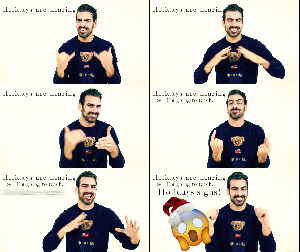
Don’t leave out any hard of hearing children who come to your door this Halloween, take a minute out of your day to learn a few seasonal asl signs! These are two different variations of “Happy Halloween” Click here for my source.
halloween is for everyone!!!!!!
this is honestly the cutest thing ever 10/10 will do this year💗💗
And here are the British Sign Language versions. (I love the BLS sign for Halloween. It’s so cute.)
Deaf inclusion for every holiday!
Love this! I also posted a video the other day of different signs from about 90+ countries for “Happy Halloween” 🙂
AAVSL (African American Venacular Sign Language) is wild because you really see the culture in it and if you are Black and hearing/don’t know ASL, you still understand it because so much of black communicatiom is nonverbal
Reblogging again because I didn’t know AAVE had a sign language equivalent even though now it makes so much sense.
I have a mute character in the story I’m writing and one of my beta readers suggested I use italics when they sign so that I don’t have to keep peppering “they signed” or “their hands flashed” throughout the piece.
But like…I always read italics in a different tone like they’re thoughts. It seems quieter than using normal quotations which makes what they say look less significant on the page than other character’s dialogue.
I really don’t think my audience needs me to use completely different punctuation around a mute character. There’s no need to act like they’re speaking a different language since their muteness isn’t a focal point in the story.
So really this reader’s comment has done the complete opposite of what they intended. Now I’m actively taking out as many of my “hands flashed” notations as possible and just writing in normal body language because, clearly, the other characters understand them and my audience doesn’t need to be coddled.
As an HOH reader and writer I can affirm that once the signing has been established it can just be treated like “said”.
You can add little things for emphasis though, like how fast or flippant a sign is given, also a lot of our “punctuation” is in facial expressions, so wild looks is kind of normal. Also messing up signs and just.. pushing them aside. Like, you mess up a fingerspell and just take both hands and shove the air in front of you to your side, people who sign eventually end up doing this for other things, like a “forget it” motion. It’s like a “wave it off” gesture.
Body language for someone who signs is a lot more animated than someone who speaks, as we use our upper body a lot in our conversations, so the act of “signing” is more than just hand signals.
Yes….yes GOOD this is the good stuff right here. I’m going to incorporate some of these ASAP ESPECIALLY the pushing the air but to clear it of your mistakes
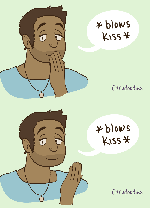
A little PSA about ASL for ‘Thank you’! I’ve had all of these signed to me accidentally hahaha. And when I sign thank you to non signers, sometimes they thought I was blowing a kiss to them. T_T
the asl sign for “transgender“ is basically the same as the sign for ”beautiful“ but signed at the chest instead of in front of the face.
so that’s cool.
this is my imperfect not-a-fluent-signer understanding but:
(based on a presentation by a deaf trans guy i was at in 2005 where he was promoting that sign)
it seems like that sign was invented and implemented by trans people over the last 10-ish years. before that the predominant vocabulary was “sex change” and then some deaf trans people were like “yo fuck that” and came up with the current sign, which starts off with the sign for “myself,” then motion that indicates both change and coming together, and ends with the closed hand held against the sternum.
and in the process it also mimics the sign for “beautiful”
and because of spatial grammar, things closer to the front of your body in ASL are generally more vital, more emphatic, more immediate, more present.
so it’s actually a case where the word coherently indicates “beauty” and “self transformation” and contains hints of the complete thought of “my self transforming, through a coming together of disparate factors, into something more real, immediate, and vital than I was before.”
so yeah. that’s just fuckin’ awesome.
and that’s just the way to express that concept now.
Thats really beautiful
So the most direct translation would be something like “transforming into my most beautiful self”?
There’s a website where you can learn ASL on your own and it is free and the woman on there, her name is Rochelle Barlow, she runs the site and she actually is a homeschool teacher and teaches ASL. I am passing this on to you guys cause most people on here is open-minded. Well, whoever of y’all reads this will possibly ignore this but if you are a curious george like me and wants to learn ASL she’s your gal.
Rochelle has a free program called Learn ASL in 31 days, currently I am on day 10ish or 12, (idk I’m on learning my numbers currently) but I believe this site will help people that are either curious about ASL and just wants to learn, or actually is Deaf but can’t afford to going to actual class or something, or just hard of hearing.
I am truly in love with learning with Rochelle, she isn’t those interpreters that will talk while she signs, (and I’ve searched through Youtube how to sign but the person talking will distract me and I would get confused) and it is all in video which is a good thing. I found her through Youtube, that’s where she has all her videos. Just check out her site. You’ll like it.

















 bullshit central