Before I get going, I’m 75% deaf, as some of you know, semi-reliant on hearing aids and lip reading. My first languages were Makaton sign and then BSL. I now use spoken English.
There are a lot of issues I find with how deaf people are represented in books, when represented at all. I would love to see more deaf and hard of hearing characters in the books I read- without having to read books specifically about deaf/HoH people- but when I find them, they’re grossly undercharacterized or stereotyped. Authors write them in a way that sets signing language characters apart from speaking characters as if they are inferior, and this makes my blood boil.
Some technicalties
I’ll keep this brief.
You may have heard that “deaf” is a slur and you should use “hearing impaired”. Don’t. I’ve never met a deaf or hard of hearing person who believed that. Use deaf for people who are deaf, and Hard of Hearing (HoH) for people who lack hearing. These can be interchangeable depending on the person. This is why sensitivity readers are a useful part of the beta process.
Sign language is incredibly varied. It developes in the same way as spoken language. Fun fact: in BSL there are at least half a dozen ways to say bullshit, my favourite of which is laying your arms across one another with one hand making a bull’s head sign and the other hand going flat, like a cowpat. It’s beautifully crude, and the face makes the exclamation mark. Wonderful.
There are different sign languages. Knowing more than one would make a character multi or bi-lingual, even if they are non-speaking.
Makaton is basic sign language used by children, and it mirrors the very simple language used by toddlers.
Yes, we swear and talk shit about people around us in sign language sometimes, and no, it isn’t disrespectful to have signing characters do this. Just remember that we also say nice things, and random things, and talk about fandoms and TV shows and what we’re having for dinner, too.
Each signed language is different from another. ASL and BSL? Nothing alike. Just google the two different signs for horse.
Remember that sign language is a language, equal to the spoken word
Therefore, treat it as such. Use quotation speech marks and dialogue
tags. You only need to explicitly state that this character uses signed language once, and then let your modifiers and description do the rest.
It isn’t a form of “sub-speech" or “making hand actions”- sign language is a language all on its own: it has its own grammar rules, syntactical structures, punctuation, patterns, idioms and colloquialisms. For example, “what is your name?” becomes “Your name what?” with the facial expression forming punctuation in the same way that spoken English uses alterations of prosodic tone (inflections). There is even pidgin sign; a language phenomenon usually associated with spoken language.
In the same way that you would describe a spoken-English character’s tone of voice, you would describe a signed-English speaker’s facial expressions and the way that they sign- keeping in mind that these things are our language’s equivalent of verbal inflection.
So please, none of that use of “special speech marks” or italicised
speech for sign. If your viewpoint character doesn’t understand signed
speech, then you take the same approach that would be used for any other
language they don’t understand, like French or Thai. E.g “He said something
in rapid sign language, face wrinkling in obvious disgust.” is a good
way of conveying this. The proof that you’ve done this well is in whether or not you can switch “sign language” for French or something else, and it would read the same.
Don’t be afraid to describe how things are said, either.
Sign language is such a beautiful and expressive way of talking, and to
see a writer do it justice would be truly fabulous. Putting this into practise:
“Oh, I love maths!” She said, fingers sharp and wide with sarcasm. She raised her eyebrows.
“I’m sorry.” He replied and made his face small, but could not keep the grin forming. She was starting to laugh, too.
This is part one of two, for the sake of readability and keeping the information simple as I can. Part two- writing the deaf characters themselves- is coming up over the weekend. See you then and best luck with your writing until that point 😀
This is part of my weekly advice theme. Each week I look at what you’ve asked me to help with, and write a post or series of posts for it. Next week: settings and character development (including heroes, anti-heroes, villains, and every other kind of character).
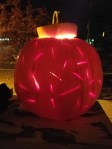
Not sure if it qualifies, since I forgot about dating it, but this is my pumpkin, Julius. Can’t really see the pumpkin goo bleeding from his 23 stab wounds in the dark. 😦
-@lokitura
You are the winner of the Halloween Carving contest!
i just saw a fb post where a man was arguing with a woman about the best way to make macarons and he kept insisting that she was wrong, and then eventually he was like “I’ve never personally made macarons, but if you think about it what I’m saying makes sense, i’m simply stating the obvious. i’m sure there are plenty of youtube tutorials that would show you the same thing.” and the woman replied by linking him to her instagram business page and she makes fuckin macaron towers for parties for a living and i’ve been laughing about it for a solid 5 minutes.
Men automatically assume they’re more of an expert on something than any woman on account of their dicks. I’ve never met such an ignorant and narcissistic creature as a male
I’ll never forget a time when a fb friend of mine posted that she’s on her way to hospital to give birth. Women commented with “good luck” and other encouraging messages. A man’s comment was advice on how to give birth.
You have got to be kidding me
So I was talking about Jekyll & Hyde (the book) at a writer’s museum while we were looking at an Robert Louis Stevenson exhibit. I was giving my take on Jekyll, and my brother tried to counter it. I countered back easily, and then he said “well I’ve never read the book”
My dude………..stop
my ex, whose baking experience was pretty much limited to frying premade biscuit dough in boy scouts to make ‘donuts’, would constantly try to correct me or give me advice on baking
i’m a fucking pastry chef
met a dude at a party who was talking about physics and asked if i’d ever listened to any online physics lectures bc he listened to all of this one series and they were so helpful and maybe i could learn some physics too
i have a degree in physics
and am a published coauthor in astrophysics
the best part is that the woman who invented the term ‘mansplaining’ (her name is Rebecca Solnit and i highly recommend her collection of essays) came up with it when she was at a party one night and a man tried to explain a book to her, and wouldn’t let her speak long enough for her to tell him that
she wrote the bloody book he was mansplaining to her
You know I have plenty examples of this but that last one takes the cake so imma just let it be.











 bullshit central