My first ask meme, and one that’s been on my mind for a while! Feel free to reblog for your it for yourself, answer them, or ask me for my answers! Read more break after 10/50 to help keep this from clogging any dashboards
1. What was your first fic and could you stand to reread it today?
2. What’s your most recent fic and how far do you think you’ve come?
3. In your opinion, what’s your best fic?
4. In your opinion and without looking at any numbers, what’s your most popular fic?
5. Is there any fic that makes you super happy to reread and remember you wrote that?
6. Is there any fic that makes you super embarrassed to reread and remember you wrote that?
7. What’s the fic you most want to continue (unfinished or no)?
8. What’s the oldest (longest since last update) fic you most want to continue (unfinished or no)?
9. Have you ever written for a fandom without watching/reading/playing the source material?
10. Have you ever written for a fandom without reading other fanfic for it?
Author: snorlaxlovesme


My young child’s teacher, showing me a drawing of my family in front of our home with a horrifying monstrous figure floating above us in crayon: we’re….concerned
Me, who can see ghosts and can tell how wrong my kid got the depiction of our house’s Horror Terror that walks our halls at night: yeah me too my kids fucking sucks at drawing huh
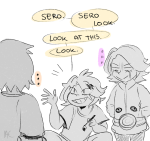
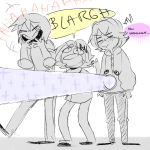
When you’re writing your first draft and you know it could be better

The reason I think it’s so important to fight the narrative that JKR couldn’t have done any better in her novels, particularly arguments that attribute that to them being children‘s books, is that so many authors out there- and specifically so many authors of young adult and middle grade and even picturebook fiction- actually do the work to make sure representation is present.
Publishing, and especially big six publishing, absolutely has a long way to go in terms of representation. But the decision to erase the representation we do have, in order to defend the most powerful among us, doesn’t do anything to support those texts, but does a lot to erase the work of the people who perhaps aren’t as well known, but are conscious of who their words impact when they write them.
There is so much wonderful LGBTQIA+ content in children’s and young adult literature right now, and there was in the 2000s and there was as far back as 1969 when I’ll Get There It Better Be Worth the Trip killed the dog, and it is basically professional malpractice for anyone remotely involved in the field of children’s literature to let claims that JKR did as much as she could go unchecked.
This this this.
To make the bare minimum comparison, look at what Rick Riordan has done. He’s another author who built his way to huge power in the publishing industry. And what has he done with it?
He’s put LGBT people on the page in his books. He’s told these kids they have a place in his stories.
And now he’s using his power to launch his own imprint RAISING UP the voices of newer authors, particularly authors of color, and making sure other mythologies are portrayed on the page in a respectful way.
That is how you support representation on the page, particularly when you are a person with privilege in the position to do so.
Thanks for bringing up Rick Riordan, which is SUCH a good point.
Kids loved his mythology series so much that they asked for other cultures’. And this dude basically said “Look, I’d love to, but it’s not my place, but I can leverage my reach and fame.” So he teamed up with his publisher to highlight other authors’ work. His Hyperion imprint, Rick Riordan Presents, has announced the following four deals so far (descriptions from Publishers Marketplace):
- NYT bestselling author Roshani Chokshi’s debut beginning with ARU SHAH
AND THE END OF TIME, pitched as Percy Jackson meets Sailor Moon with
Indian mythology, when a twelve-year-old lights a lamp in the Museum of
Ancient Indian Art and Culture in order to impress her friends, she
unwittingly frees the Sleeper, an ancient demon whose duty it is to
awaken the God of Destruction and bring an end to Time
- It releases in March! Check out the awesome cover and maybe order it now!
- Yoon Ha Lee’s DRAGON PEARL, in which Lee draws on his Korean heritage to
tell the story of a teenage fox spirit whose brother is missing and
thought to have deserted the Thousand Worlds Space Forces in order to
find the pearl of the title, an artifact that may have the power to save
their struggling space colony- Rebecca Roanhorse’s RACE TO THE SUN, about a seventh-grade girl and her
brother who, aided by various Navajo gods disguised as relatives, must
stay one step ahead of a shape-shifting monster as they follow in the
footsteps of the legendary Hero Twins to save their family- Carlos Hernandez’s SAL AND GABI BREAK THE UNIVERSE, the story of a
Cuban-American boy who can meditate things—and people—from other
universes into his own(I should note here that I know there have also been problems from Rick Riordan, specifically in his use of the term “half blood.”
I believe I read at some point that he cut down on using it after
hearing the implications, but I can’t find any evidence of that. I do
know that when he was called out for using the term “spirit animal“ he contacted his publisher and got it removed from future printings.
I don’t know how much any/all of these contributed to his learning to
do better, and ultimately using his platform to support marginalized authors.)Riordan- a cisgender straight white man- also won the Stonewall Award for his writing of a genderqueer character, and his speech upon winning is worth taking a look at:
I think, to support young LGBTQ readers, the most important thing
publishing can do is to publish and promote more stories by LGBTQ
authors, authentic experiences by authentic voices. We have to keep
pushing for this. The Stonewall committee’s work is a critical part of
that effort. I can only accept the Stonewall Award in the sense that I
accept a call to action – firstly, to do more myself to read and promote
books by LGBTQ authors.But also, it’s a call to do better in my own writing. As one of my
genderqueer readers told me recently, “Hey, thanks for Alex. You didn’t
do a terrible job!” I thought: Yes! Not doing a terrible job was my
goal!As important as it is to offer authentic voices and empower authors
and role models from within LGBTQ community, it’s is also important that
LGBTQ kids see themselves reflected and valued in the larger world of
mass media, including my books. I know this because my
non-heteronormative readers tell me so. They actively lobby to see
characters like themselves in my books. They like the universe I’ve
created. They want to be part of it. They deserve that opportunity. It’s
important that I, as a mainstream author, say, “I see you. You matter.
Your life experience may not be like mine, but it is no less valid and
no less real. I will do whatever I can to understand and accurately
include you in my stories, in my world. I will not erase you.”No one has told JKR that she has to do as much work as Rick Riordan is doing (although it would certainly nice). But her decision to say there’s representation without ever featuring it on the page or on screen is so far below bare minimum as to be disgraceful.

being a cashier is so stressful i’ll be like “hi! how are you :^)” and the customer will hand me a screwdriver and say “my granddaughter had a miscarriage this morning” and I’m like …………………..i’m so sorry that’s $2.33
Deadass I once told a customer “Have a nice day!” and he responded that he couldn’t because it was the anniversary of his wife’s murder
 bullshit central